BigBasket Delivery App 2.0
Optimizing Gigs:
A Smarter Way to Schedule Work
Delivery App Management
Workforce
Backend Management
-SIDDHARTHA GUPTA
What did I do?
I built a structured gig management system from the ground up, enabling delivery partners to seamlessly discover, book, and manage their shifts. My role spanned end-to-end product design right from research and defining user pain points to crafting intuitive flows and high-fidelity designs. I worked closely with stakeholders to align business needs with user experience, ensuring flexibility and transparency in shift scheduling.
Prototyping, usability testing, and close collaboration with engineering helped shape a frictionless system that optimizes workforce efficiency while keeping partner needs at the center.

My role
Product Designer - User Research,
Conceptualisation, UI/UX Design,
Prototyping, Usability Testing & Handoff
Team
1 Product Designer, 2 UX Researchers
& 3 Product Manager and a Team of 12 Engineers
Teamline
3 weeks including design for all users, shipped in Jan 2025 across all partners in India
PROBLEM
The Chaos
Previously, delivery partners had no structured way to schedule their shifts. Their availability was either managed by store managers or left to their discretion, leading to inconsistencies.
Sometimes, they would arrive at the store only to find all slots full, forcing them to return later.
Peak-hour demand was communicated via WhatsApp groups, but without real-time slot visibility, partners had no way of knowing if work was available when they arrived. This lack of clarity resulted in inefficiencies, frustration, and missed earning opportunities.
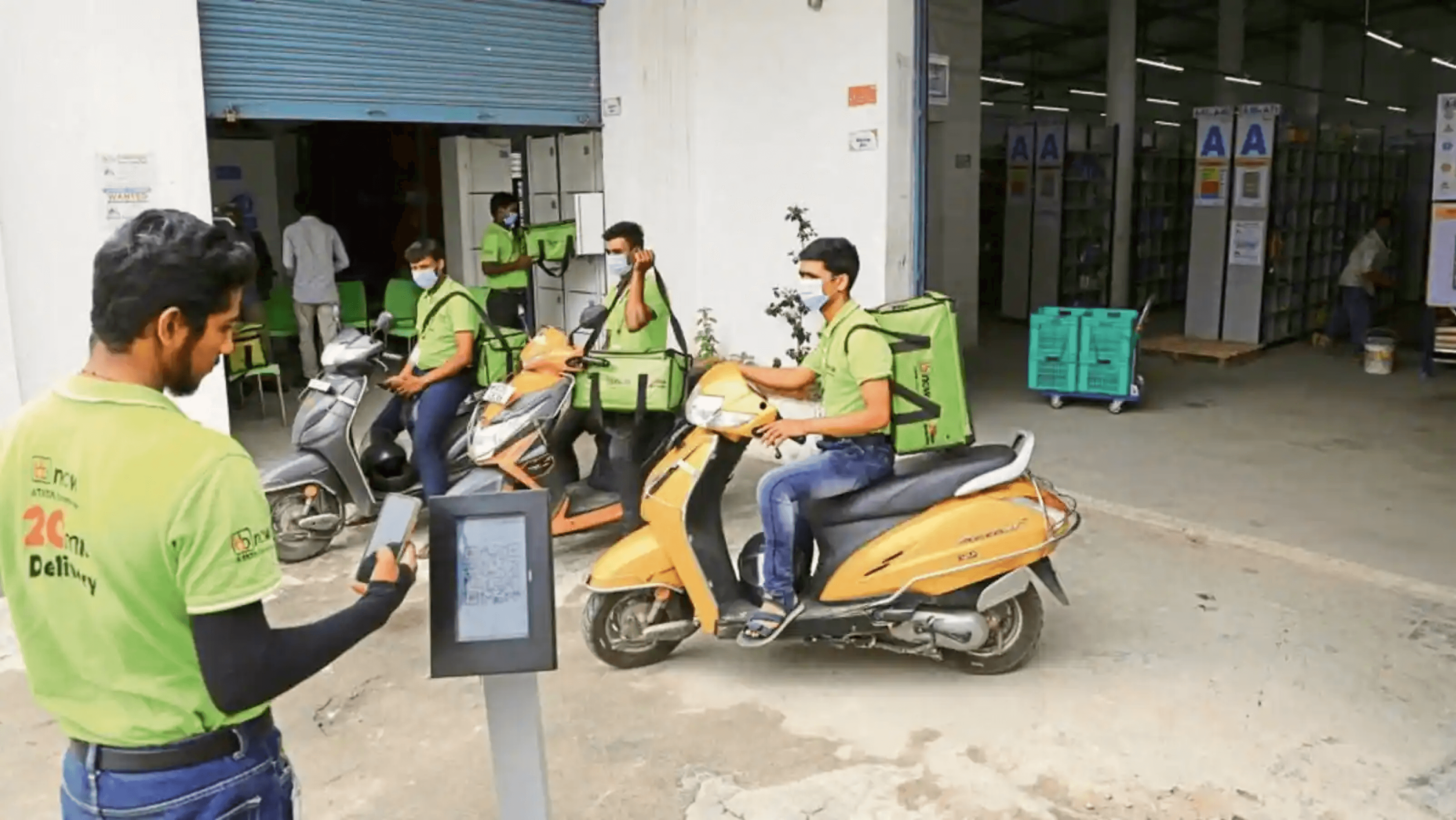

Delivery partners reaching the stores to log in and plan the date ahead.
💡
Problem Statement
The manual rostering system lacked transparency, causing uncertainty, last-minute conflicts, and operational inefficiencies. Delivery partners needed a self-service gig scheduling system to plan shifts in advance, reduce manual dependencies, and ensure smoother operations.
DEFINE
What can possibly come into play?
The idea came from seeing how hard it was for everyone—delivery partners unsure of their schedules, operations teams stuck fixing errors, and everyone feeling the stress. The team thought, why not move this online? Not to make it fancy, but to make it simple.
A place where everyone could easily plan & check their gigs, without the confusion or hassle.
It was about making life a little easier for everyone.
😖
I don’t know which store to report to if I want to work only during peak hours?
See? This is what goes in the mind of almost every delivery partner, everyday.
😕
I am really uncertain about my gigs today. I can’t plan anything ahead.
🤔
How many shifts would I be able to do in the morning?
😨
I don’t know which store to report to if I want to work only during peak hours?
Hence, the team sat down and brainstormed how impact would it be if rostering activity is moved online?
Book gigs in advance?
Easily manage their day?
Avoid on-store hassle?
Give them a peace of mind?
Plan ahead for multiple days?
Defining The Goal
To address the scheduling chaos, we needed a system that was intuitive, fair, and seamlessly integrated into the delivery partner's workflow. The goal was not just to replace manual rostering but to create a structured, self-service solution that empowered partners while improving operational efficiency.
Here’s what we set out to achieve:
🔍
Clarity & Self-Service
Real-time gig visibility and independent booking without store managers.
Simple UI
real-time slot visibility
instant confirmations
📅
Predictability & Allocation
Advance scheduling with fair gig distribution based on demand.
Advance booking
gig distribution
transparent rules
⚡
Operational Efficiency
Minimized conflicts with real-time updates and backend integration.
Backend Automation
real-time updates
notifications/reminders
🚀
Scalability & Future Growth
Demand-based slot allocation and expansion for new gig worker features.
Flexible System
demand-based slots
Features Expansion
IDEATION
Conceptualisation
With the problem clearly defined, the next step was to conceptualize a solution that would streamline gig booking while ensuring fairness and efficiency. The focus was on empowering delivery partners with a self-service system, reducing reliance on manual coordination, and bringing real-time clarity to shift availability. By categorizing gigs and implementing live updates, we aimed to create a scheduling experience that was intuitive, transparent, and scalable.

Self-Service Gig Booking
Empower delivery partners to book shifts independently through the app.
To allow instant booking and cancellations with clear confirmation messages?
HMW design an intuitive booking interface in the app for easy navigation?
Provide filters and search options to help partners find suitable gig slots.
Gig Categorization for Clarity
Define Mandatory, Peak Hour, and Missed gigs to improve scheduling transparency.
HMW categorise & highlight the different gig types?
Provide color-coded or labeled slots for easy identification?
Structure shift types into - mandatory, peak and missed gigs.
Real-Time Availability Updates
Display open slots dynamically to prevent overbooking and reduce uncertainty.
Implement auto-refresh features so partners see the latest gig availability.
Use live inventory tracking to display available, booked, and missed slots.
HMW notify partners via push notifications when new slots open or changes occur?
PROTOTYPE
Designing & Prototyping
To streamline gig scheduling, the design focuses on accessibility, transparency, and ease of use. Key features ensure delivery partners can quickly check their schedules, book gigs effortlessly, and track their performance without hassle. By integrating these elements into a seamless experience, we empower partners with the tools they need to plan their work efficiently.


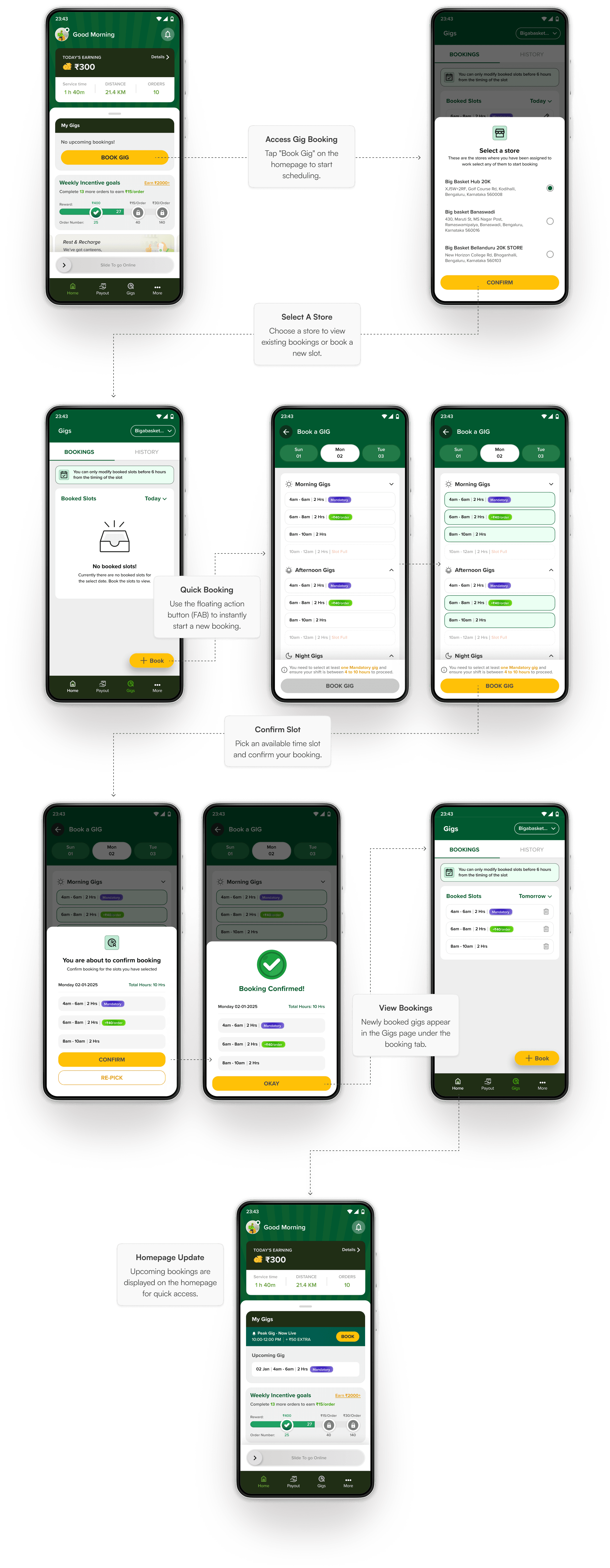
User Flow
The user flow is designed to ensure a quick and smooth booking experience. From the initial step of accessing the booking feature to confirming a slot, each stage is streamlined for efficiency. This seamless flow keeps users informed and in control at every step.
USER TESTING
Feedback & Validation
User testing is essential to evaluate the effectiveness of the gig booking flow and ensure it meets the needs of delivery partners. By focusing on key parameters such as ease of use, clarity, speed, error handling, and user satisfaction, we can assess how well the design supports users in managing their bookings. The goal is to identify any friction points, validate design choices, and make adjustments that enhance the overall experience, ensuring the flow is intuitive, efficient, and reliable.

Delivery partner on the road waiting for the lights to turn green.
User testing is a crucial step to ensure that the gig booking flow meets the needs of delivery partners. By focusing on different categories, we can comprehensively evaluate the design's performance across key aspects. The following parameters will guide the testing process:
Ease of Use
How quickly can users complete the booking process without confusion?
Satisfaction
Do users feel confident and satisfied with the booking experience?
Clear Messages
Is gig availability and booking status clear and easy to understand?
Real-Time Updates
Do updates for slot availability and booking status make any difference?
Navigation
Is the flow intuitive and easy to navigate from one step to the next?
Speed
How fast is the entire booking process, and are there any delays?
Response
How do users respond when they encounter an issue ?
Handling
Do the error messages provide easy guidance for resolving the issue?
Key Insights
User testing provided valuable insights into the effectiveness of the gig booking flow. The data highlights the design’s success in improving booking efficiency, user confidence, and error handling, confirming that the system meets user needs and enhances the overall experience.
⏳
Reduced Time to Book
85% of users completed the booking process within 2 minutes, demonstrating the efficiency and ease of use of the one-page booking system.
This supports the design's focus on streamlining the booking flow.
😌
Improved User Confidence
78% of users reported feeling confident about their booking status, with clear indicators of upcoming gigs on the homepage.
This highlights the design’s effectiveness in providing clarity and reducing uncertainty.
🕹️
Positive Error Handling Feedback
92% of users who encountered booking conflicts (e.g., overbooked slots) found the error messages helpful and easy to follow.
This confirms that the system’s error handling is intuitive, guiding users to resolve issues quickly.
REFLECTION
Learnings
👥 Cross Functional Collaboration
🗒️️ Better Adaptability
🗣️ Improved Communication
Working on the gig booking system provided me with key insights into designing user-centered solutions. From simplifying complex processes to ensuring smooth integration with backend systems, this project reinforced the importance of clarity, efficiency, & scalability.
It also taught me the value of continuously iterating based on user feedback, while keeping future growth in mind to ensure the system can adapt to changing needs.
In the end, I believe this design has made a meaningful impact on the lives of our delivery partners, who work tirelessly to deliver for us. 💚